
Echoing the Valley’s Song
Reflections from Gulay Pa More! (Written by Lyra Puno, Programme Officer for Gender-equal Community Agency and Voice, GCAV)
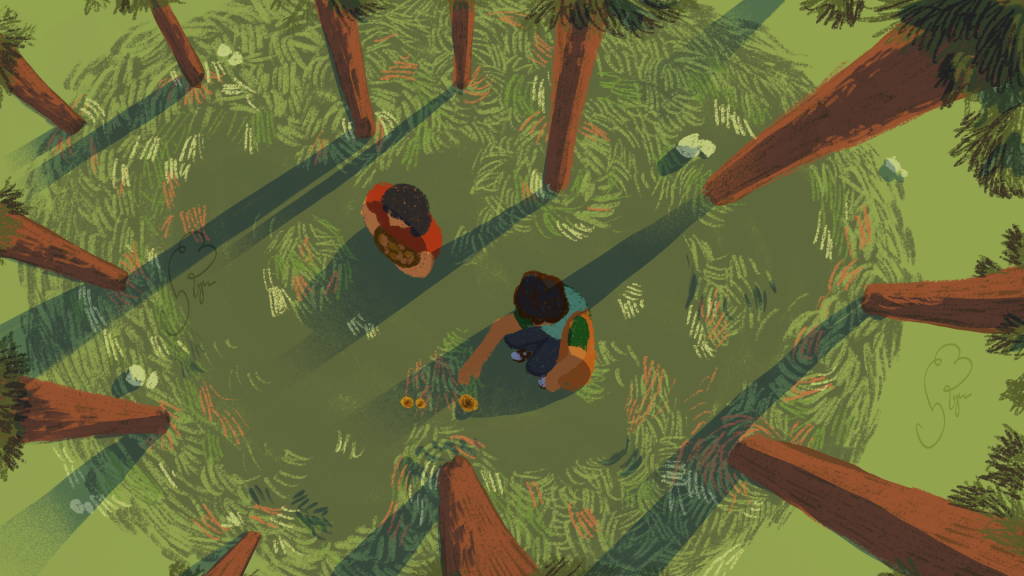
Illustration by Lyra Puno, GCAV Programme Officer (NTFP-EP Asia)
The regional organization, Non-Timber Forest Products – Exchange Programme Asia (NTFP-EP Asia) attended the Gulay Pa More Sagada: Ikaduwa, which was successfully conducted last 12-14 of June, in Sagada, Mountain Province.
While this is the first time that NTFP-EP Asia attended the event, this activity is already the second installment of the festival’s offshoot that is specially contextualized for Sagada’s landscape, hence bearing the name “ikaduwa” which translates to “second” in Kankana-ey and also in Ilokano. The series of festivals of Gulay Pa More began in 2024, in the parking lot of the College of Social Sciences and Philosophy, University of the Philippines Diliman, Quezon City. It was meant to be a festival that highlights the abundance of Philippine flora, and in this context, it became a celebration of Philippine heritage, biodiversity and community spirit with the people of Cordillera.
The 3-day event started jam-packed with plenary learning sessions of participating individuals, organizations, and Indigenous Peoples and Local Communities (IPs & LCs) from Cordillera. There were simultaneous field-visits and breakout sessions led by some of the event’s local partners. The first day was not only to welcome the approximately 200 participants hailing from across the Philippines to Sagada, but also to set the foundation for the entirety of the event. The local partners of the Gulay Pa More Sagada: Radyo Sagada, APIT-Sagada, Echo Valley Farm, Barangay Balugan, Barangay Bangaan, Baguilota Art Space were all highlighted this day, providing context on how they have all come to see nature as an entity that is not separate from their identity.
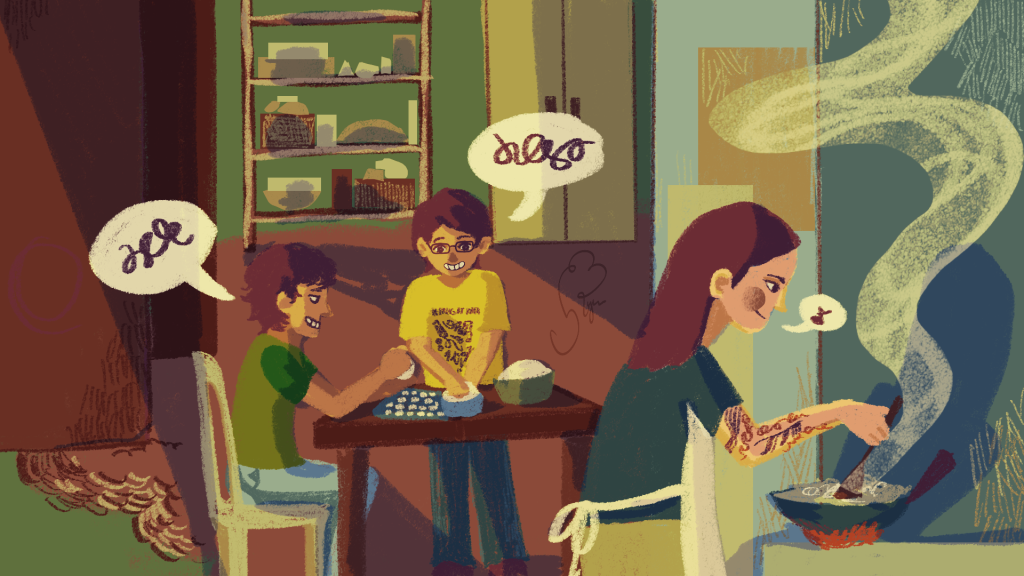
Illustration by Lyra Puno, GCAV Programme Officer (NTFP-EP Asia)
The second day commenced with Market Day, where participants were given the opportunity to immerse themselves in the local market where communities from neighboring provinces also sell their produce. Then the participants were guided by local mushroom foragers in different areas, to experience foraging firsthand. After this, the mushrooms foraged by all participants were sorted by local experts, Chris Angway and Marco Lobregat, and welcomed questions they could address using their field of expertise. Using mushrooms foraged in the Cordillera forests and fresh produce from the local market, participants fragmented into groups to cook their own contributions to the community dinner. On the second night, an event in the town hall was opened to the public, inviting locals of Sagada town proper to join a night celebrating culture and solidarity.
Upon reflections and sharing of the groups subdivided into the breakout sessions and into foraging/community cooking groups, there were several prominent themes that arose.
Collective action and community
It is not sufficient to just long for a community, it is imperative that one must be able to be willing to become a community to belong to a community. This theme arose in several sessions: in Unas breakout session, where from harvesting to processing of muscovado called for joint effort; in Kapi breakout session, where the participants were shown community transcended life – that if a Sagada local perishes, the entire Sagada will grieve. It was also emphasized how collective power will strengthen not only the voices to advocate for food security, for organic farming systems, and climate action, but also the marketing power of small farmers. It is also through collectivizing farmer communities that they can create a platform to exchange knowledge on planting, harvesting, and “seed exchange”. For the participants who come from different places and have come to love the Cordillera landscape, there was a strong demand recurring to call for a broad alliance, to continue the conversation and continue the forged companionship built over the activity. For the locals of the Cordillera region, it was shared that there is a communal (“lampisa”) irrigation system that worked before parcels of land became commercialized and privatized.
Restraint, care, and patience
In the age of convenience and mechanization of processes, there was a rediscovered beauty to practicing gentleness and slowness. Patience plays a significant role in more microscopic processes such as processing muscovado to reach the optimal status of the sugar, handling clay and putting it in a kiln to finish it, fermenting and pickling vegetables to prolong the shelf life, and on a more broad and general sense, patience is necessary to address the challenge of expanding the network of organic farmers in a time where it is easier to resort to chemical farm inputs.
Starting at the grassroots level
In the Piitik breakout session, where they visited local wine-makers and also in another breakout session, Baguilota, there was a resounding sentiment that to address the needs of a community is to listen to the community and become one with them – to have a conversation, instead of a one-sided consultation and to put value in the agency of the community to decide what they believe is necessary for their forests. Manang Gwen from Radyo Sagada, an IP-led radio broadcasting station in Sagada, talks about how a global climate crisis affects the people at a local level – how climate change destroys the identities of IPs & LCs as it threatens the sanctity of their IKSPs (i.e. harvest calendars, farming practices).
No to profit-oriented perspective
The potters of Baguilota Art Space refuse to partake in commercializing their craft into mass-produced, soulless art pieces, as they believed that anything that unintentional imperfections is part of the art itself. They also source the clay they use from nature, and they get only what they need and not excessively extracting resources for their own gain. In organic farming, the concept of consuming and producing only what is needed is held with value. The concept of “seed sharing” among farmers from similar landscapes is meant to put into action the concept of community, as well, in contrast to large corporations wanting to patent and keep seeds for their own gain.
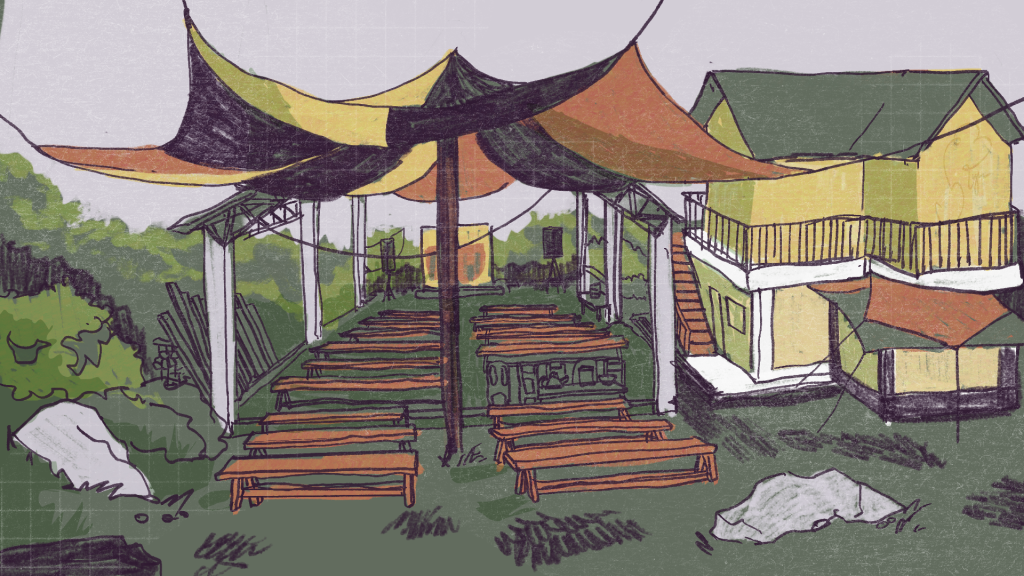
Illustration by Lyra Puno, GCAV Programme Officer (NTFP-EP Asia)
Linking peoples and forests
It is not new knowledge that IPs & LCs have a deeply-entrenched relationship with the environment and the forests, as Manang Gwen (Radio Sagada) also said, “no one else understands nature more than Indigenous Peoples.” … From revoking the concept of profiteering the environment by using only what one needs, to working with the elements in nature that surrounds you — this relation between the forests and the people of Cordillera was showcased to the participants of Gulay Pa More. They believe that the way you treat the forests is how the forests will treat you back. In Dr. Penny Domogo’s closing statement during her sharing, we should all “Live in harmony with the design of the universe.” Even in Dom-An Macagne’s bamboo flute performance, the theme of cultivating a balanced relationship with nature is woven into her music – that when nature is in balance, the wellbeing is taken care of, and thus we can dance to music.
Much like the driving principle of NTFP-EP Asia, there is a strong emphasis on not only helping to empower but to actually joining hand-in-hand with the IPs & LCs to combat negative manifestations of climate change on a grassroots level, and to amplify collective voices, bring the stories from the ground, and demand accountability from the policymakers and institutions whose decisions can easily affect the conditions of the our forests and the IPs and LCs of the Global South
The event aimed to promote food and cultural heritage, to give emphasis on the Indigenous Knowledge Systems and Practices (IKSPs) that promote agroecology, shed light into often-forgotten art of food production, arts, and community-based entrepreneurship. As this was an event that aims to be grounded not only on the surface of the land, but up to the tip of the roots, they aim to honor and support the critical role of Indigenous Peoples, Local Communities by joining the community’s advocacy in protecting their food systems, the integrity of their biodiversity, and their IKSPs, through sustained solidarity and eventually build upon this for future concrete actions.