

Improving the Quality of Timor Leste Forest Honey
Written by: Merry Tobing, a dedicated country mentor for Timor Leste in the AFoCo regional project.
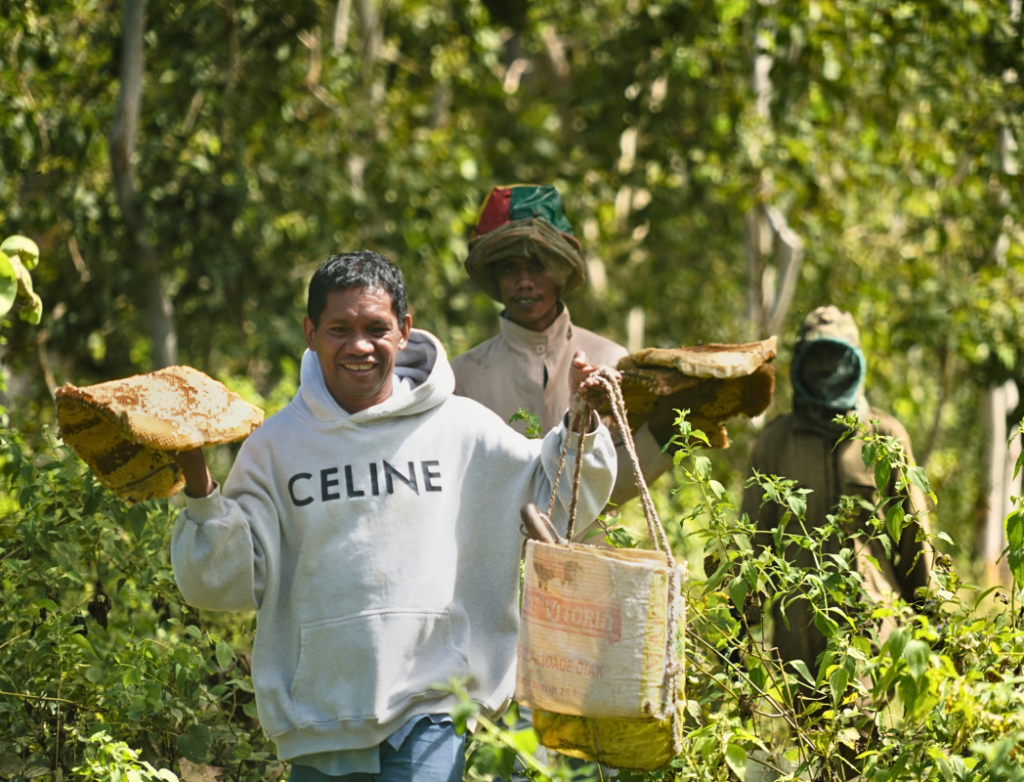
A man harvesting honey in Timor Leste Forest (photo courtesy of Timor Leste AFoCo Country Team)
“This method is good; the honey is cleaner and clearer. We didn’t know beforehand. Now, I know it and it’s easy to do, I want to do it,” said Mr. Julios, chairman of CBNE Cribas while practicing honey filtering using a drain system in Cribas village.
It was a bright morning when we started our trip from Dili city to Cribas village. Along the winding, uphill and downhill roads, you can see small stalls selling honey in used 600 ml mineral water bottles. It’s not surprising because the honey harvest season for the March – May period has just ended, and people still have stocks of honey to sell.
Honey is one of Timor Leste’s NTFPs which is a source of seasonal livelihood for people who live from the forest.

Participants from CBNE Cribas-Manatuto (Photo courtesy of Timor Leste AFoCo Country Team)
When arriving at Cribas village, after a 2-hour road trip from Dili, we were warmly welcomed by the head of Cribas village and members of the CBNE Cribas group. Yes, that day was the third day of training on Improving the Quality of Forest Honey and Market Studies for CBNE Timor Leste honey which was held by the Directorate General of Forestry – Ministry Agriculture, Livestock, Fisheries and Foresty of Timor Leste together with NTFP-EP supported by AFoCo through the project Improved local community livelihoods through increased income from non-timber forests products (NTFP): Modeling scalable community-based enterprises in Asia. The need to improve the quality of CBNE honey emerged from the capacity assessment results of CBNE and the Timor Leste Country Team at the start of the project. This training was attended by CBNE Cribas-Manatuto, CBNE Tocoluli-Ermera (5M), and staff of the Director General of Forestry. This training was opened by Director General of Forestry, Mr. Raimundo Mau Sp, MSc, and was held for three days.
Before, for 2 days participants trained in class (Dili) with NTFP-EP and Mr. Novi from the Mutis Community Network, regarding marketing, why it is necessary to maintain the quality of honey, recognizing the critical points for honey contamination, quality control points and sharing experiences in maintaining the quality of honey from existing practices, and getting to know the standardization of honey.
The Marketing Session was guided by Crissy, starting with the “Yes” or “No” game about Marketing to determine participants’ understanding of marketing. From this game, it is seen that some participants understand sales as marketing. Marketing materials begin with understanding: what marketing is, how we recognize the current condition of our business, how to identify market segments, determine targets, and plan the marketing itself. Segmentation becomes a deeper focus in this marketing session.
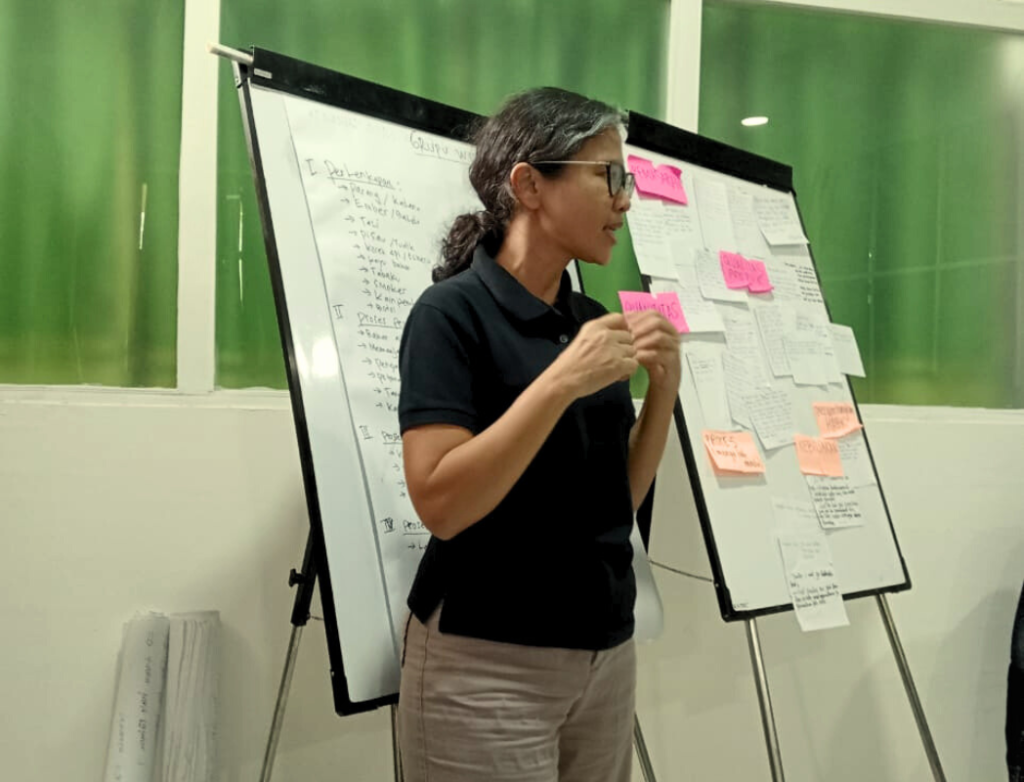
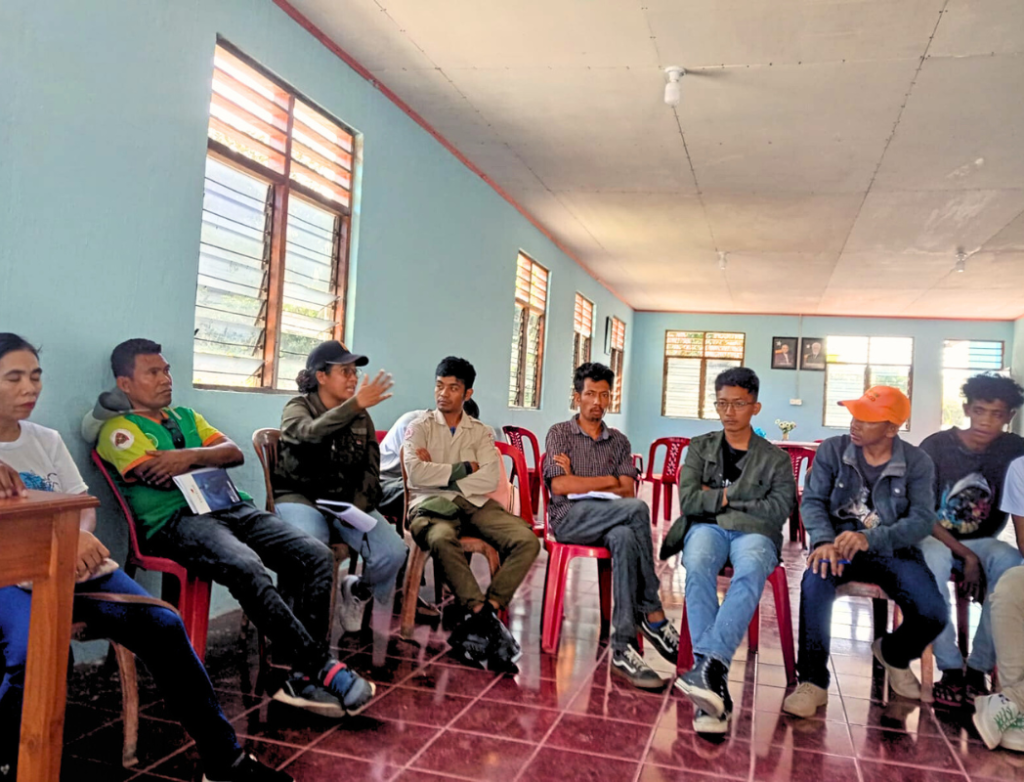
Crissy conducting Marketing Session and participants’ discussion on honey harvesting (photo courtesy of Merry Tobing)
To gain a deeper understanding of current honey marketing in Timor Leste (especially market segmentation) participants conducted in-depth group discussions (FGD) with honey producers (Mr. Carlito, an Atauro honey producer), honey consumers (one of the staff of the Directorate General of Forestry) and one of one honey retailer in Dili (Seara supermarket) with discussion topics: product (packaging, size, price), honey source, honey excellence, market/consumer, sales, marketing strategy and challenges. The results of the FGD show that the people of Timor Leste like forest honey because it is authentic (from the forest), there are no mixtures, and they use honey for cough medicine but prefer honey from outside Timor Leste (especially TJ honey from Indonesia) because the honey is cleaner, sold in safe places (supermarkets), easy to get and the price is cheaper. The quality of honey, especially cleanliness, is challenging for Timor Leste Forest honey to attract local consumers. This is in line with the target of the Timor Leste Country Team for this 2-year project, namely improving the quality of forest honey and expanding the market for forest honey overseas.
To understand the importance of quality control in production, Crissy gave an example from the experience of the Ikalahan indigenous jam producer group in Imugan, Nueva Vizcaya, Philippines which was exported to Germany. One time the jam from this group was rejected by their buyers in Germany because the jam they sent was moldy. After investigating, it turned out that the cause was that the bottle cleaning process was not sterile. After this incident, the group added a bottle-cleaning process as a quality control point. Crissy also shared about The Forest Honey Collective Mark (FHCM), a marker for forest honey produced with certain standards. If we refer to the FHCM, in controlling the quality of honey, what needs to be considered in each process is the cleanliness of the tools used, the cleanliness of the place where the process is carried out, the cleanliness of the equipment, materials and honey itself, the health and cleanliness of the people who carries out the process, and guard against opportunities for contamination. Why does honey quality need to be maintained? apart from maintaining the good nutrition contained in honey, also because to enter a wider market requires honey to meet certain standards such as Codex and SNI, and honey whose quality is maintained has a better chance of meeting these standards.
The opportunity for Timor Leste’s forest honey to advance in class and be on par with honey from abroad is before our eyes
Mr. Novi from Mutis Community Network, complemented the knowledge of participants about maintaining honey quality by sharing the practice of quality control points in the Mutis Madu group’s honey production process, starting from harvest preparation, and harvesting to post-harvest (packaging). And the end of the honey quality improvement session, the CBNE Cribas and CBNE Tocoluli wrote down the sequence of activities for the forest honey production process (preparation – harvest – post-harvest) through to marketing. Participants reviewed the process and added important things in the process for controlling the quality of their honey based on what Crissy and Mr. Novi had shared.
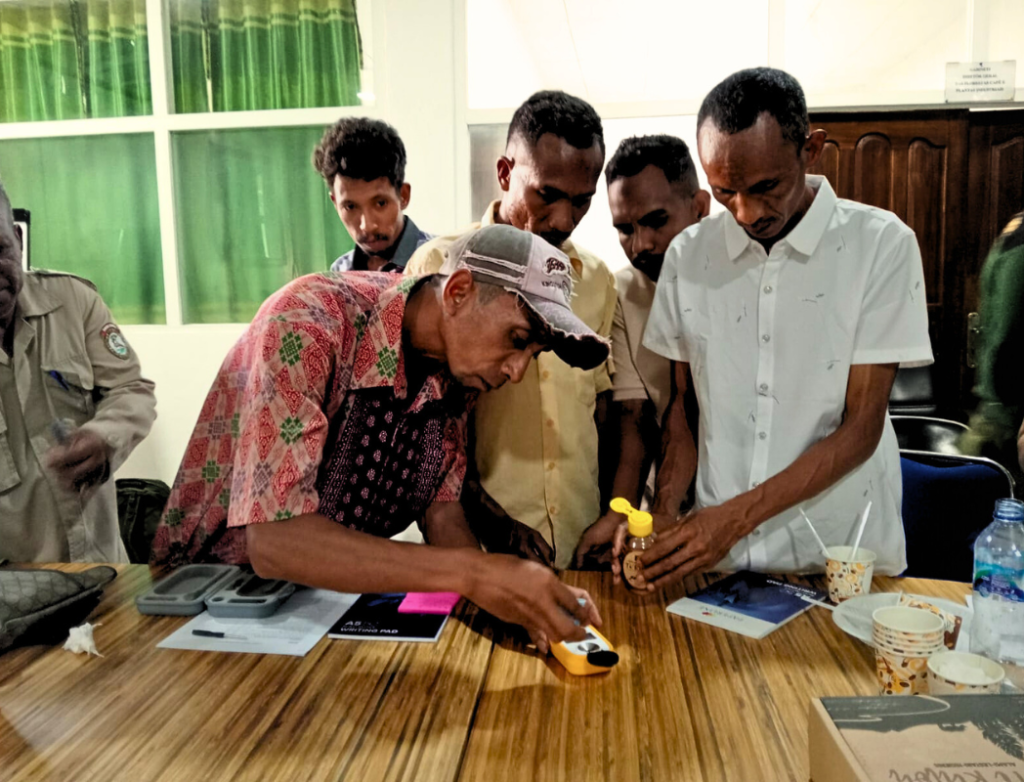
Mr. Novi explaining how to use refractometer to the participants (photo courtesy of Merry Tobing)
The field practice carried out in Cribas village was the perfect conclusion to the training. Theoretical matters related to honey quality, especially regarding honey quality control, become clearer with practice in the field. Producing honey that is clean and packaged in sterile glass bottles with safe labels and closures as well as eye-catching packaging is possible after the practice of filtering honey using the drain and bottle system taught by Mr. Novi. Mr. Novi practices filtering honey using a drain system by slicing the honey using a stainless knife, draining it in a rice steamer, and filtering using a 3-layer nets rice steamer (with different nest hole sizes) and 2 pieces of mesh cloth of different sizes (100 mm and 60 mm). At the same time, CBNE Cribas practices filtering honey using a hand-squeezing system with a strainer which is usually used in the kitchen as a filter.
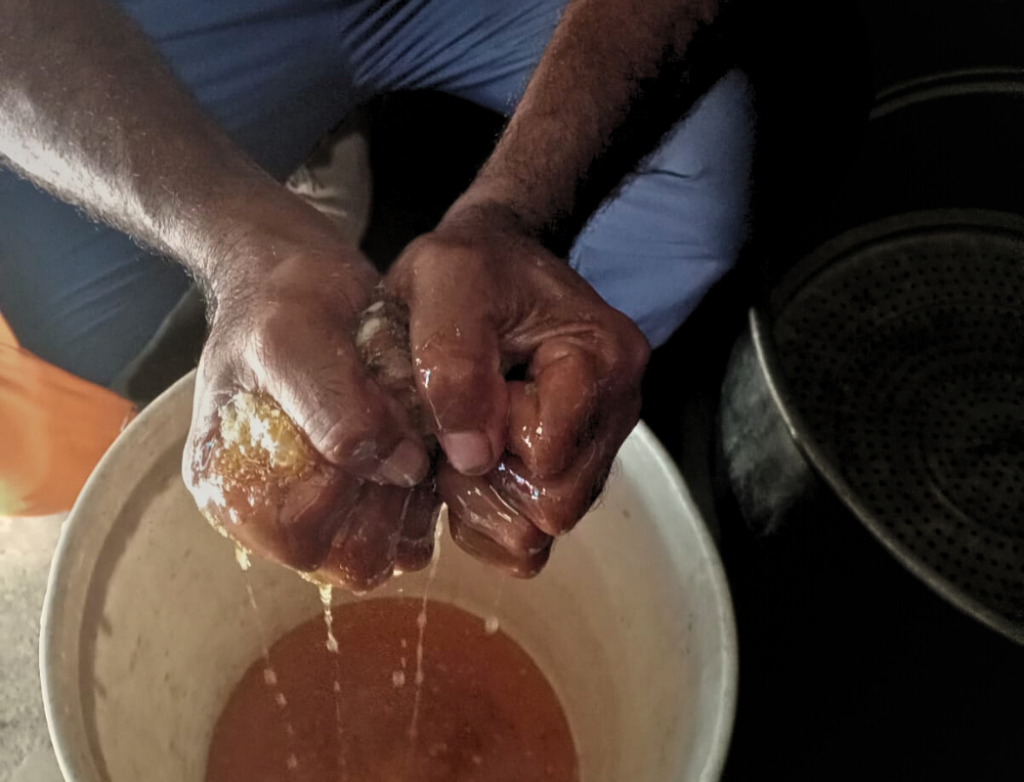
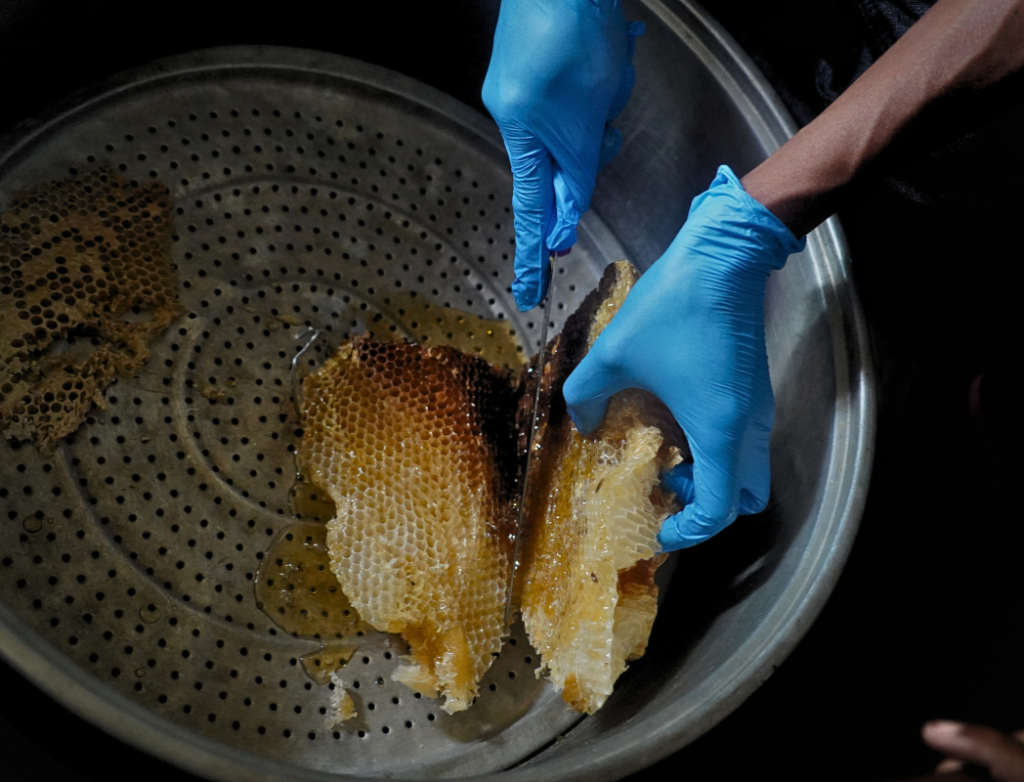
(right) Filtering honey using a hand-squeeze system and (left) filtering honey using a drain system (photo courtesy of Merry Tobing (r) and Timor Leste AFoCo Country Team (l))
The results were amazing, the honey filtered using the hand squeeze system showed white spots, was not clear and the water content was 24.6% after 2 filterings, while the honey with the drain system was clearer, cleaner, and had a lower water content, namely 23.2%, this is close to the international standard for honey moisture content, 21%, also after 2 filtering times. Packaging or bottling begins with sterilizing the glass bottle by steaming it in a steamer for 2 minutes (if using a new bottle) – 5 minutes (if using an old bottle). Attach the bottle cap using a fork. Sticking the plastic seal on the bottle cap is done by dipping the bottle covered with the plastic seal in hot water. Meanwhile, so that the labels are not easily damaged, they are coated with plastic by heating using a hot gun.
All these processes are easy to do, and the equipment is readily available, so it is possible to replicate them. It’s not surprising that not only Mr Julios was enthusiastic about practicing it during the training but most of the participants also tried draining and bottling.
Now is the time to realize the follow-up plans for each group, Cribas and Ermera, so that Timor Leste Forest honey which is currently sold on the roadside becomes honey sold in supermarkets and abroad. From local to national and going international.
Another interesting thing that is happening in the field is the exchange of knowledge between Timor Leste Forest honey producers, where the CBNE Tocoluli-Ermera is currently honey producing is decreasing because most of the honey climbers are old people and are no longer productive, while young people do not have the skills to harvest honey and are afraid to climb because the honey tree are tall. Mr. Carlito, an Atauro honey producer, suggests lowering honeybees to the shorter trees around the honey tree by applying honey to the branches of the tree. This is also known as rafter beekeeping. Mr. Carlito also shared a concoction to repel bees at harvest time, namely ginger juice smeared all over the body or honey tree climbing clothes, bees don’t like the smell of ginger.
The opportunity for Timor Leste’s forest honey to advance in class and be on par with honey from abroad is before our eyes, the participants have already gained the knowledge.
The Asian Forest Cooperation Organization (AFoCo) is a treaty based intergovernmental organization that is committed to strengthening forest cooperation and taking concrete actions to promote sustainable forest management and address the impacts of climate change.