

The PAMPA: A Land Management System by the Indigenous Women of Kulawi, Central Sulawesi (Indonesia)
In the heart of the Kulawi Subdistrict in Sigi, Central Sulawesi, Indonesia, lies a beautiful tradition known as PAMPA. This land management system serves as a lifeline for the local community–not just an important part of livelihood for the Kulawi Indigenous Peoples, but it also serves as an essential part of their identity. What others view as a simple forest, the women of Kulawi consider their personal “vegetable supermarket.” This direct access to food and traditional crops is the heart of the PAMPA system.
A short film by NTFP-EP Indonesia, Kabupaten Sigi, Siklus
The shared effort of harvesting food and traditional crops is balanced. Men are responsible for crops, such as coffee, cocoa, and most perennials including timber. In contrast, women are the constant stewards of the PAMPA. This system, rooted in a deep historical connection to nature, utilizes managed plots near their homes for daily sustenance. By planting and regularly collecting everyday necessities like chili and corn, the women ensure the family’s nutrition and health, providing direct sustenance for their families.
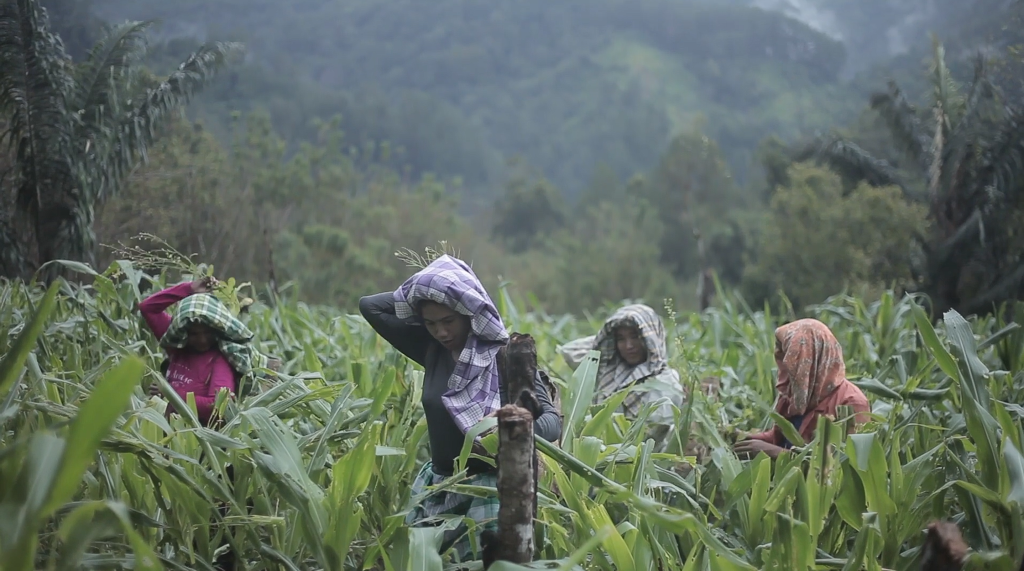
(Screen capture from the short film, all credits to NTFP-EP Indonesia, Kabupaten Sigi, and Siklus
One of the most inspiring parts of the PAMPA system is a tradition is the rotational group work system where women come together to manage the land as a team. Instead of working alone, they support one another, sharing labor and passing down local wisdom from one generation to the next.
A System Under Threat
Despite PAMPA being the lifeline for the people of Kulawi, this way of life is facing a serious challenge. Much of the PAMPA area is being converted into farm plots for crops like coffee and cocoa. When the land changes, the social structure changes too. Because coffee and cacao are usually managed by men, women risk losing their access and rights to managing the PAMPA area.
The impact is felt immediately on their respective family’s expenses. Without their “vegetable supermarket,” women are forced to buy food from outside traders. This means the money earned from selling coffee or cocoa must often be spent to buy the very vegetables they used to grow in their own backyards, their PAMPA area.
Protecting the Future
Women leaders like Martina, who is both a motivator and an expert in PAMPA management, are now striving to make their voices heard–that this system is a long-withstanding symbol of food security for the people of Kulawi. They hope to show the world that when women are empowered to be stewards of the environment and encouraged to be at the forefront of agriculture and forestry, the entire community thrives.
The goal now is to get the local and national government of Indonesia, as well as the private sectors, to recognize the PAMPA system as an absolutely essential traditional ecological knowledge. It is a testament of the cultural identity of the Indigenous Peoples of Kulawi.
Protecting PAMPA areas ensures that the women of Kulawi can continue safeguarding and sustaining their customary lands, keeping their families fed and their culture alive for generations to come.
The Green Livelihoods Alliance (GLA) is dedicated to promoting sustainable resource management in the Lariang Landscape of Sulawesi, Indonesia, the Philippines, Malaysia, and Vietnam. In Indonesia, GLA’s interventions are concentrated in twelve (12) villages across the Sigi and Poso Districts of Central Sulawesi. This initiative that started from 2016 and has recently concluded in 2025, aims to empower and enhance Indigenous and local communities’ capacities for resource utilization and welfare improvement. This is achieved through close cooperation with local partners in Sigi, with organizations like Perkumpulan Inovasi Komunitas (IMUNITAS) and KARSA Institute and in Poso, with Yayasan Panorama Alam Lestari (YPAL) and Relawan Orang Untuk Alam (ROA), as well as national-level collaboration with the Working Group for ICCA (WGII) to advocate for land and forest governance rights.